
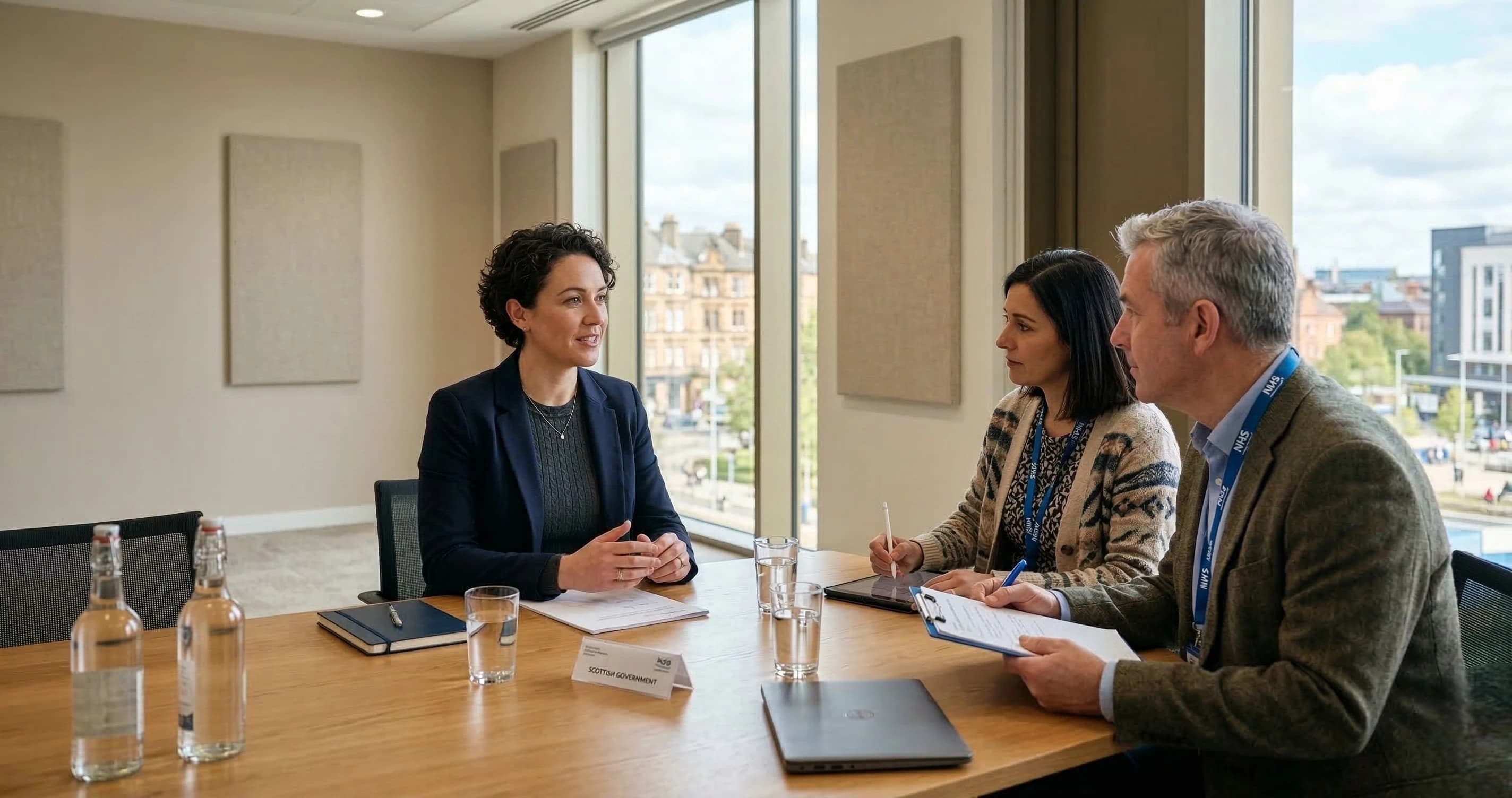
If you've applied for a job with NHS Fife or Fife Council and been invited to interview, there's a good chance you're facing a competency-based interview. This format catches a lot of candidates off guard — not because it's unfair, but because most people don't prepare for it the right way.
The good news: competency-based interviews are one of the most learnable interview formats out there. The structure is predictable, the questions follow a pattern, and if you put in a few hours of preparation, you can walk in with confidence.
Here's everything you need to know.
What Is a Competency-Based Interview?
A competency-based interview (sometimes called a structured or behavioural interview) is designed to assess how you've handled real situations in the past. The principle behind it is simple: past behaviour is the best predictor of future performance.
Instead of asking "Are you good at working under pressure?", an interviewer will ask something like: "Tell me about a time when you had to deal with a difficult situation under pressure. What did you do?"
Your answer needs to be a real example — not a hypothetical, not what you would do, but what you actually did.
Both NHS Fife and Fife Council use this format across most of their roles because it allows them to assess all candidates consistently and fairly. Every candidate gets the same questions, and answers are scored against the same criteria. For a large public sector employer hiring hundreds of people a year, it keeps the process transparent.
The STAR Technique: Your Framework for Every Answer
The STAR technique is the standard method for structuring competency answers. Once you understand it, you can apply it to almost any question thrown at you.
Situation — Set the scene. Where were you working? What was happening? Give enough context that the interviewer understands the background.
Task — What was your specific responsibility? Be clear about what you were asked to do or what you took ownership of — not what the wider team was doing.
Action — This is the most important part. Describe exactly what you did, step by step. Don't say "we decided to..." — say "I did..." The interviewer is assessing your individual contribution.
Result — What happened? Quantify it where you can ("waiting times dropped by 20%", "resolved the complaint within 24 hours") and reflect briefly on what you learned.
A solid STAR answer runs about two to three minutes when spoken aloud. Any shorter and you're likely underselling the Action; any longer and you're drifting.
Common Competencies Asked in Public Sector Interviews
NHS Fife and Fife Council will typically share the competency framework they're assessing before your interview — check your invitation letter or the job pack. Common ones you'll encounter include:
- Teamwork — Working collaboratively to achieve a shared goal
- Communication — Explaining complex information clearly, or adapting your style for different audiences
- Resilience — Staying effective when things go wrong or workloads increase
- Problem-solving — Identifying issues and finding practical solutions
- Adaptability — Responding positively to change or learning something new quickly
- Leadership or initiative — Taking ownership, motivating others, or driving improvement without being asked
For healthcare roles at NHS Fife, you're also likely to be assessed on patient care values, confidentiality, and working within professional guidelines. For Fife Council roles — whether that's in administration, education, or social care — expect questions around equality, community impact, and working with the public.
How to Prepare Your Examples
The mistake most candidates make is trying to think of examples on the spot in the interview room. By then it's too late — under pressure, your mind goes blank or you reach for the first thing that comes to mind, which is rarely your strongest example.
Prepare before you go in. Sit down with the list of competencies and brainstorm two or three examples for each. Draw from:
- Previous jobs (paid or voluntary)
- College or university projects
- Community or committee work
- Caring responsibilities
- Work placements or shadowing
You don't need to have managed a team of fifty people. Interviewers at Fife Council and NHS Fife understand that candidates come from all sorts of backgrounds. What they're looking for is self-awareness, honest reflection, and a clear explanation of what you did and why.
Once you have your examples, write them out in STAR format. Reading them back aloud — even to yourself — makes a big difference. It's the difference between knowing your examples and being able to deliver them clearly under interview conditions.
Skills Development Scotland's My World of Work has a solid guide to the format worth bookmarking too.
Using AI to Prepare (This Is Worth Doing)
One of the most underused preparation tactics for competency interviews is practising out loud — and AI tools like ChatGPT make this much easier than doing it alone.
Generate likely questions. Paste the competency framework from your job pack into ChatGPT and ask: "Generate 10 competency-based interview questions for a [job title] role at an NHS trust, focusing on these competencies: [list them]." You'll get a realistic bank of questions to practise with.
Run a mock interview. Ask ChatGPT to act as an interviewer. Give it your answer, then ask it to score the STAR structure: "Was my Situation clear enough? Was the Action section specific? Did I quantify the Result?" It's surprisingly good at spotting where an answer loses clarity.
Sharpen weak examples. If you have an example that feels a bit flat, paste the rough version in and ask: "How could I make the Action part of this more specific and impactful?" or "This answer feels long — what can I cut without losing the key points?"
Prepare for follow-up questions. Interviewers often probe with follow-ups like "What would you do differently?" or "How did your manager respond?" Ask ChatGPT to throw follow-ups at you after each answer so you're not caught off guard.
It's not cheating — it's the same as doing a mock interview with a friend, just available at midnight the night before your interview.
For more on using AI in your job search, see our guide on how to use AI to write your CV.
On the Day
A few practical notes for the interview itself:
Take your time. It's completely acceptable to pause for a few seconds before answering. Saying "just give me a moment to think of the best example" is far better than rushing into a weak one.
Ask for clarification. If you're not sure what competency the question is targeting, ask. "Is that question focused on communication, or more on problem-solving?" Interviewers expect this.
Don't recycle examples. If you use the same story for two different questions, flag it — "I used a similar example earlier, but I can give you a different one if that's more helpful." They'll usually appreciate the honesty.
Be honest about outcomes. Not every example has to end in triumph. A result where things didn't go perfectly but you learned something and adapted is often more impressive than a tidy success story.
Whether you're applying for a nursing role with NHS Fife, an admin post with Fife Council, or something in between, the preparation process is the same. Get your examples ready, practise them out loud, and trust the structure.
If you're still weighing up whether NHS Fife is the right employer for you, read our full guide to NHS Fife jobs at Victoria Hospital Kirkcaldy — it covers the types of roles available, pay bands, and what to expect from working there.
Browse current healthcare jobs in Fife or council and public sector roles on Kirkcaldy Jobs — and good luck with the interview.